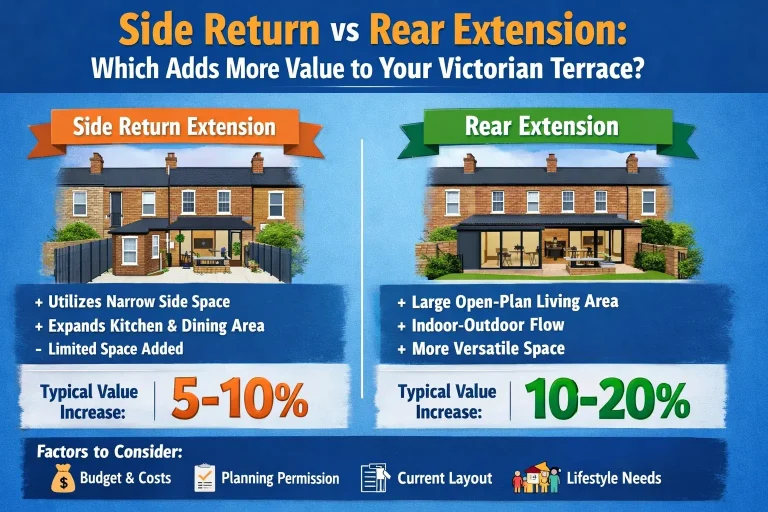

If you own a Victorian terrace in London, you’re sitting on a property with incredible potential. These characterful homes were built for a different era—long, narrow layouts with small kitchens tucked away at the back. But with the right extension, you can transform your Victorian terrace into a spacious, light-filled family home that commands a premium on today’s market.
The question most homeowners face is this: should you invest in a side return extension or a full rear extension? Both can dramatically increase your living space and property value, but they serve different purposes, come with different price tags, and deliver different returns on investment.
At Brit Home Design & Build, we’ve completed hundreds of Victorian terrace extensions across London over the past 25 years. In this guide, we’ll break down the real costs, planning considerations, and value-add potential of each option to help you make an informed decision.
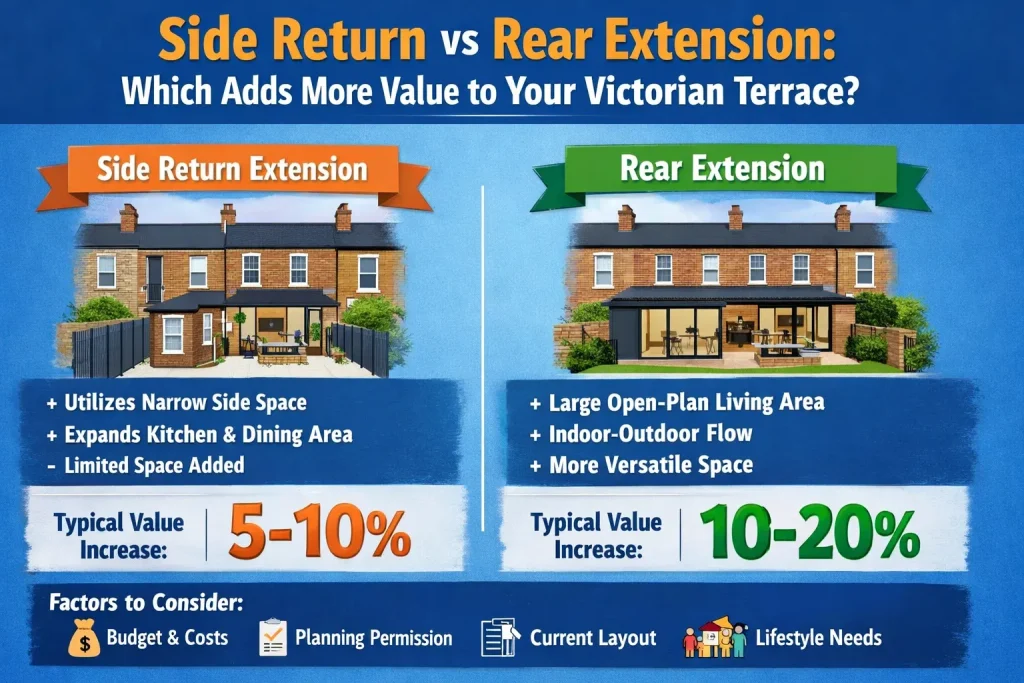
Understanding the Victorian Terrace Challenge
Most Victorian terraces share a common layout problem. They’re built on narrow plots with a side alley (the “return”) running alongside the kitchen. This side passage is typically 1-1.5 metres wide and serves little practical purpose beyond housing bins and providing side access to the garden.
Meanwhile, the original kitchen and dining areas are cramped, dark, and disconnected from the garden. For modern family living, this layout simply doesn’t work.
What is a Side Return Extension?
A side return extension reclaims that wasted side passage space by building across it. The result is typically a 1-1.5 metre width gain along the length of your ground floor, which is then combined with your existing kitchen to create a wider, more functional room.
Typical footprint: 3-5 square metres
Average cost in London (2026): £35,000 – £55,000
Planning requirements: Usually permitted development (no planning permission needed)
Advantages of Side Return Extensions
Cost-effective transformation. For a relatively modest investment, you eliminate a dark corridor kitchen and gain a room that feels twice as wide. The change in how the space feels and functions is often greater than the square meterage suggests.
Usually permitted development. Most side return extensions fall within permitted development rights, meaning no planning application is required. This saves you time, money, and the uncertainty of the planning process.
Faster build time. A straightforward side return can be completed in 6-8 weeks, meaning less disruption to your household.
Better kitchen layout options. That extra metre of width opens up new possibilities for kitchen design—island units become feasible, you can add a proper dining area, and the space no longer feels like a narrow galley.
Limitations of Side Return Extensions
The main limitation is scale. You’re only adding 3-5 square metres, so while the improved layout feels transformative, you’re not creating an entirely new room. If you need significantly more space—say, for a large family dining area or open-plan living zone—a side return alone may not be enough.
What is a Rear Extension?
A rear extension projects out from the back of your property into the garden. For a Victorian terrace, this typically means extending 3-6 metres beyond the original rear wall.
Typical footprint: 15-30 square metres
Average cost in London (2026): £65,000 – £120,000+
Planning requirements: May require planning permission if extending beyond permitted development limits
Advantages of Rear Extensions
Substantial space gain. A 4-5 metre rear extension can nearly double your ground floor living area, creating a genuine open-plan kitchen, dining, and living space.
Garden connection. With large bi-fold or sliding doors spanning the rear elevation, you create a seamless indoor-outdoor connection that completely changes how you use your home.
Higher ceiling potential. Rear extensions often incorporate vaulted ceilings or roof lights, flooding the space with natural light and creating a real ‘wow factor’ that side returns can’t match.
Flexible design options. The larger footprint gives you more freedom to incorporate kitchen islands, dining areas, family zones, and even utility or boot rooms.
Limitations of Rear Extensions
Higher cost. You’re looking at roughly double to triple the investment compared to a side return, and costs can escalate quickly if you add premium finishes or structural complexity.
Garden loss. Extending 4-6 metres means sacrificing that space from your garden. For families with young children or those who value outdoor space, this is a significant consideration.
More complex planning. Larger rear extensions often require formal planning permission, particularly if you exceed the permitted development limits (generally 3 metres for terraced properties, though this varies).
The Hybrid Approach: Wrap-Around Extensions
Here’s what many savvy London homeowners choose: a wrap-around extension that combines both a side return and a rear extension. This creates an L-shaped addition that maximizes ground floor space while maintaining some garden.
Typical footprint: 20-35 square metres
Average cost in London (2026): £85,000 – £150,000+
Value add: Often delivers the highest ROI for Victorian terraces
A wrap-around extension gives you the width from the side return and the depth from the rear extension, creating a genuinely expansive open-plan space. This is the option we most commonly recommend for families who want to create a standout kitchen-living-dining area.
Which Option Adds More Value?
The honest answer: it depends on your local market and your property’s starting point.
In premium London markets (Clapham, Wandsworth, Islington, etc.), estate agents consistently tell us that a well-executed wrap-around extension can add £80,000-£150,000 to a property’s value—well above the cost of the work. The key is that you’re creating the kind of spectacular family living space that buyers in these areas actively seek and are willing to pay a premium for.
A side return alone typically adds £40,000-£70,000 in value. The ROI percentage is strong (often 100-150%), but the absolute value gain is lower simply because you’re adding less space.
A rear extension without the side return sits in the middle, typically adding £50,000-£100,000, though this varies significantly based on the quality of the finish and how well you’ve maximized natural light.
What Should You Choose?
Choose a side return if:
- Your budget is £35,000-£55,000
- You mainly need to fix a dysfunctional kitchen layout
- You want to avoid planning permission
- You want a faster, simpler project
- Your garden is already small and you can’t afford to lose more
Choose a rear extension if:
- You need significant additional living space
- Creating an impressive entertaining area is a priority
- You have garden space to sacrifice
- Your budget is £65,000+
- You’re comfortable with a longer, more complex project
Choose a wrap-around extension if:
- You want to maximize value and space
- You’re planning to stay long-term or positioning for top resale value
- Your budget is £85,000+
- You want the ‘complete transformation’ that sets your property apart
Making It Work: Design Matters
Whatever you choose, the design execution matters enormously. A poorly designed rear extension can feel like a dark, cold box tacked onto your home. A well-designed side return can feel like a complete transformation.
Key design elements we always prioritize:
- Maximizing natural light through large glazed doors, roof lights, or glazed roofs
- Maintaining ceiling height to prevent the extension feeling like an afterthought
- Quality materials that complement your Victorian property’s character
- Seamless integration with existing rooms through careful floor level matching and opening sizes
The Bottom Line
For most Victorian terrace owners in London looking to maximize value, the wrap-around extension delivers the best return on investment. It creates the kind of spectacular family living space that commands a significant premium in the market.
However, if budget is tight or you simply need to make your existing space work better, a side return extension offers excellent value for money and can transform how your home feels and functions.
At Brit Home Design & Build, we work with you to assess your property, understand your goals, and design an extension strategy that delivers the best outcome for your budget and circumstances. With over 25 years of experience and hundreds of Victorian terrace projects completed across London, we’ve seen what works—and what doesn’t.
Ready to explore what’s possible for your Victorian terrace? Contact our team for a free consultation and site assessment. Let’s turn your cramped Victorian kitchen into the heart of your home.